
Materials Selection and Compliance in Industrial Oxygen Piping Systems
Highlights
- CGA and EIGA guidance provide a practical framework for selecting metals and non-metals for industrial oxygen piping systems.
- Exemption Pressures and pressure-velocity criteria help engineers determine whether metals comply with accepted industry practices.
- Oxygen Fire Risk Analyses provide a path forward when materials, operating conditions, or applications fall outside established compliance criteria.
- WHA helps manufacturers and oxygen users evaluate materials for compliance and compatibility, perform compliance reviews and oxygen fire risk analyses, and train engineers in these practices.
Because materials can ignite and burn more easily in the presence of oxygen, selecting compatible materials is an important part of designing systems and components for service with oxygen, and critical for avoiding fires.
For metals, industry practice relies on a structured compliance-based approach that helps engineers more easily determine whether a particular alloy can be safely used under specific operating conditions. This approach, documented in CGA G-4.4 and EIGA Doc 13 for gaseous oxygen (GOX), and CGA G-4.14 and EIGA Doc 200 for liquid oxygen (LOX) and cold GOX, has become one of the most widely used tools for selecting materials in industrial oxygen piping systems.
Elliot Forsyth, PE, serves as the Principal Engineer over Hazard Analysis and Technical Training at WHA. Below, he outlines the approach for selecting materials for compliance and how to determine when additional analysis through an oxygen fire risk analysis may be necessary.
Why Material Selection is Important for Oxygen Service
Metals and non-metals in GOX and LOX must meet typical pressure system requirements for pressure containment and sealing, respectively, along with other system-specific requirements. Still, they must also exhibit a resistance to ignition mechanisms that may be present in their use environment.
For example, one of the primary threats to industrial oxygen piping systems is particle impact ignition, in which small particles traveling at high velocity can strike surfaces within components and piping, igniting and generating sufficient energy to ignite surrounding materials.
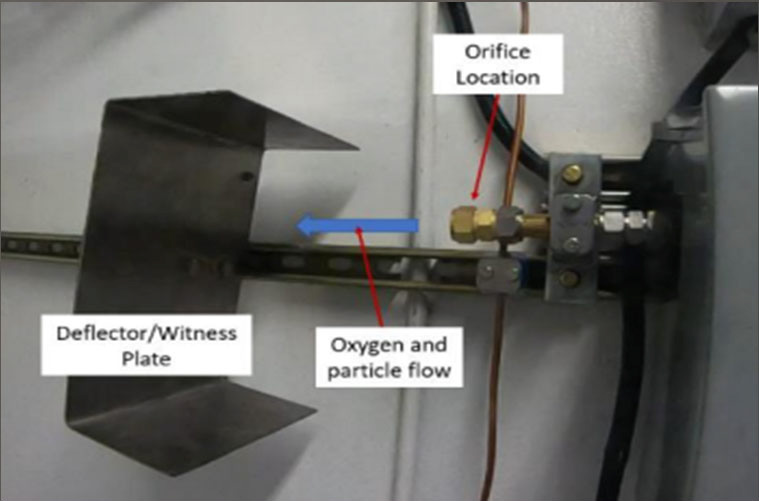
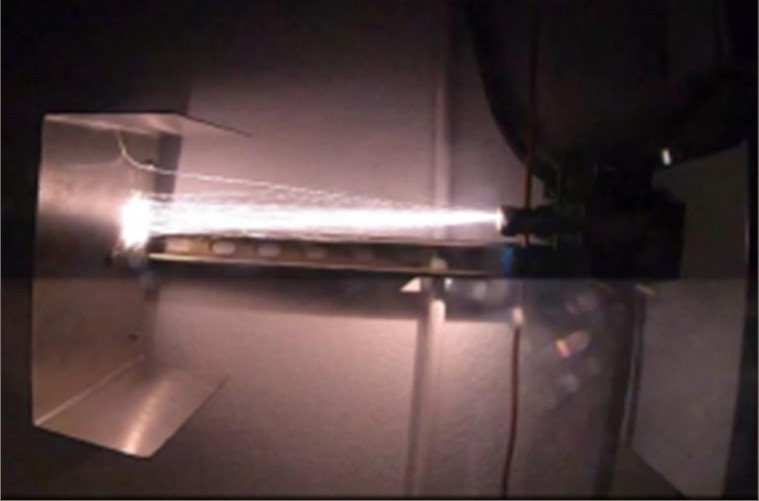
Once ignition occurs, flammable materials in oxygen-rich environments can rapidly support combustion, leading to burnout and loss of pressure containment with catastrophic consequences such as equipment damage or even loss of human life.
A Different Approach for Metals vs. Non-Metals
Non-metals, such as polymeric seats and seals, as well as lubricants, typically require qualification through testing and evaluation of their relative ignition/combustion properties, including autoignition temperature (AIT per ASTM G72 or ISO 21010 testing), mechanical/pneumatic impact sensitivity (ASTM G86, ASTM G74 testing), and heat of combustion (HoC) (per ASTM D4809 testing).
By contrast, metals are selected using a step-by-step set of practical engineering criteria that combines materials flammability data based on thickness, operating pressure, application gas velocity, and decades of industry experience.
The result is a compliance-based process that allows engineers to efficiently select materials that meet these criteria.
Further Reading: Nonmetals Oxygen Compatibility: Guide to CGA/EIGA Compliance
Understanding Exemption Pressures
“The harmonized CGA/EIGA approach has organized decades of industry experience into a set of criteria for common engineering alloys,” Elliot explains. “This approach allows engineers to make practical material selection decisions without conducting extensive analysis for every component in a system.”
Exemption Pressures (EP) represent the maximum pressure at which a specific alloy may be used without velocity limitations to reduce particle impact ignition concerns.
If a material is used below its exemption pressure and meets applicable minimum thickness requirements, it is generally considered compliant based on its inherent burn-resistance as demonstrated in standard testing per ASTM G124. However, if an engineer wants to use that alloy above its exemption pressure or in thinner cross sections than the minimum thickness, a second set of criteria can be applied to demonstrate Compliance based on its pressure and the application gas velocity.
What Happens When a Material Is Not Exempt?
Exceeding a material’s exemption pressure does not automatically make it Non-Compliant with CGA/EIGA guidance for the application.
“For low velocity applications, the standards provide a second set of criteria that may still allow a metal to be used above its published exemption pressure or thinner than its published minimum thickness,” says Elliot.
These additional pressure-velocity (PV) criteria can be used to demonstrate Compliance by showing that the gas velocity is lower than expected to ignite particles, indicating the alloy is at low risk of particle-impact ignition under the intended operating conditions. Thus, a non-exempt alloy can still be Compliant based on exposure to low gas velocity.
Based on this approach and these criteria, many organizations benefit from a formal Materials Compliance Review (MCR).
An MCR evaluates compliance based upon:
- Materials of construction
- Operating pressure and application thickness
- Application gas velocity during all phases of operation, including start-up, shut-down, and steady state
- Pressure system configuration
- Applicable CGA and EIGA criteria
- Potential areas requiring additional analysis
The result is a documented assessment of compliance and identification of any potential concerns.

Compliance Is Not the Same as Risk Analysis
Engineers need to understand that compliance reviews and oxygen fire risk analyses serve different but complementary purposes.
A Materials Compliance Review answers the question: “Does this system comply with established industry guidance, such as CGA and EIGA?”
An Oxygen Fire Risk Analysis (OFRA) answers a different question: “What is the ignition risk for this specific oxygen application?”
“Compliance is meant to set up guardrails to help you ‘color inside the lines,’” explains Elliot. “Those guidelines are intentionally conservative, and as a result, you’ll probably end up with a very low ignition probability for your material selection.”
But not every application fits neatly within those criteria, and the criteria don’t readily apply to other ignition mechanisms inherent in some oxygen equipment. New materials, unique operating conditions, specialized equipment, budgetary constraints, and non-standard designs may require a more specific analysis based on flammability and ignition data.
“There are all kinds of examples where compliance guidelines do not work for your application,” says Elliot. “In all of those applications, an OFRA is the next step and still considered a Compliance step since OFRAs are acknowledged by the CGA/EIGA standards as a path towards materials Compliance by demonstrating a low fire risk.”
Why Manufacturers and End Users Need Both Approaches
For large industrial oxygen systems containing hundreds or even thousands of components, performing a detailed OFRA on every item would be impractical.
Compliance reviews provide an efficient screening tool that helps engineers quickly apply compliance criteria to select materials or otherwise determine where additional analysis is required.
“You need a tool that can quickly evaluate certain criteria and reach a conclusion,” says Elliot. “Either those materials are compliant, or they are non-compliant, and you need to do some further analysis.”
This combination of compliance review and targeted risk analysis has become a practical, widely accepted strategy for industrial oxygen piping systems and the industry.
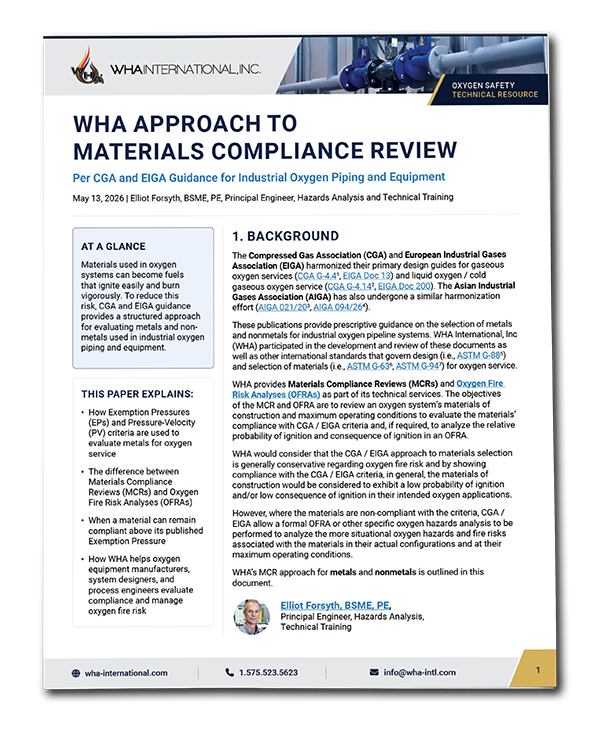
Download the Free Guide
Materials Compliance Review for Oxygen Systems
Download WHA’s free practical guide to materials selection and compliance review using CGA/EIGA criteria.
Training Engineers to Make Better Decisions
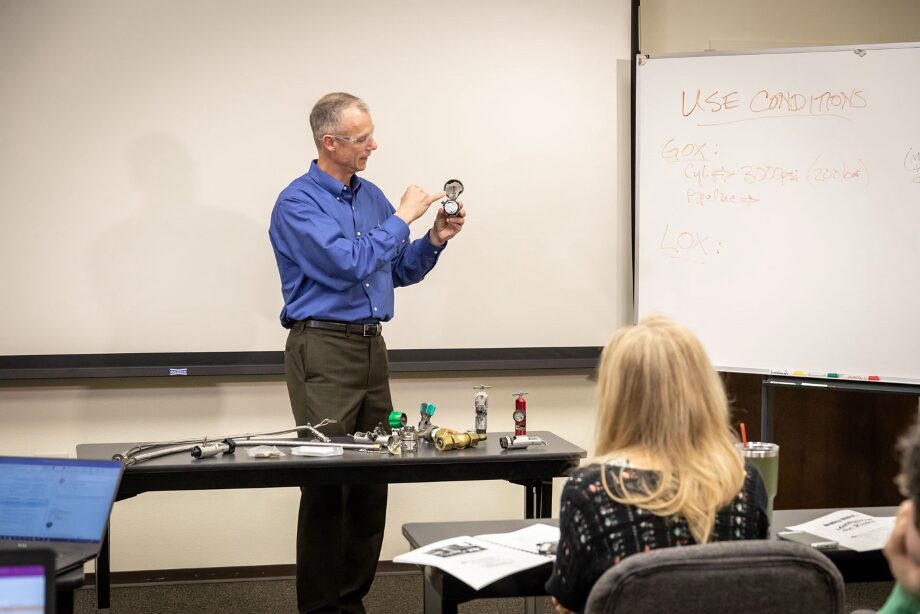
Many engineers have access to CGA and EIGA documents but struggle to translate the requirements into real-world design decisions.
“We all know what it’s like to try to read through a standard,” Elliot explains. “If somebody reads it cover to cover, the information is all there, but it’s not always written in a way that is intuitive and easy to apply.”
That challenge is one reason materials compliance concepts are a focus area for WHA’s Level 3 O2 Design and Level 4 O2 Analyze oxygen safety training curriculum. Participants learn not only what the criteria are, but also how to apply them effectively during design reviews, equipment evaluations, and hazard analyses.
When to Contact WHA
Whether you’re designing a new oxygen system, evaluating an existing installation, or reviewing a proposed material substitution, WHA can help.
Our team routinely assists clients with:
- Materials Compliance Reviews (MCRs)
- Oxygen Fire Risk Analyses (OFRAs)
- Oxygen compatibility testing
- Pressure system design reviews
- Industrial oxygen safety training
Contact us to request an expert consultation.
Share this article
Related Articles
Key Oxygen Safety Discussions from the ASTM G04 Committee Meeting at MIT
Officers from WHA International participated in the June 2026 ASTM G04 Committee Meeting, hosted by the Massachusetts…
WHA Expert Insights Improve Process Hazard Analyses (PHAs)
If you work with pressurized fluids, you already know that a Process Hazard Analysis (PHA) is a…
What New CSA Group Research Reveals about Hydrogen Leak Testing Gaps
How do we reliably detect, measure, and manage hydrogen leaks? A new CSA Group research study takes…
Request an expert
consultation
Contact us to request a free consultation with an experienced engineer who can help you better understand your needs and our solutions.