
Guide to Materials Compliance Review for Oxygen Systems
Download this free technical guide to learn how CGA and EIGA criteria are used to evaluate metals and nonmetals for industrial oxygen piping and equipment.
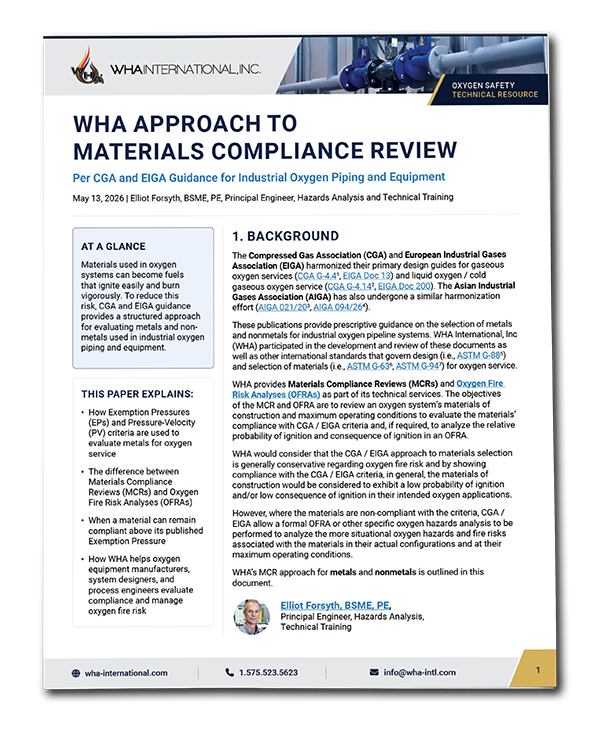
What's Inside
A Practical Guide to Oxygen Materials Compliance
The Compressed Gas Association (CGA) and European Industrial Gases Association (EIGA) harmonized their primary design guides for gaseous oxygen services (CGA G-4.4, EIGA Doc 13) and liquid oxygen / cold gaseous oxygen service (CGA G-4.14, EIGA Doc 200). The Asian Industrial Gases Association (AIGA) has also undergone a similar harmonization effort (AIGA 021/20, AIGA 094/26).
This guidance provides valuable criteria for selecting materials used in industrial oxygen piping and equipment, but applying it to a specific component or system is not always straightforward.
This free guide organizes the relevant criteria into a practical review process that engineers can use to evaluate materials, document compliance, and identify areas requiring further analysis.
Inside the Guide

Meet the Author
Elliot Forsyth, BSME, PE
Principal Engineer, Hazards Analysis and Technical Training
Download the Free Guide
Download the free guide and learn how WHA evaluates materials against accepted CGA and EIGA criteria.
"*" indicates required fields
We’ll use your information to send the guide and share occasional resources related to oxygen safety, design, and compliance. You may unsubscribe at any time.