
Guide to ASTM G93-2025: A Risk-Based Update to Oxygen Cleanliness
Highlights
- ASTM G93 provides full lifecycle guidance from defining oxygen cleanliness needs to cleaning, verification, packaging, and preservation.
- WHA’s Brad Forsyth led a task group that published a major update to ASTM G93 at the end of 2025.
- The update shifts from a prescriptive “practice” to an educational “guide,” emphasizing risk-based decision-making for oxygen cleanliness.

ASTM G93 is a familiar reference for many engineers who work with oxygen systems. It’s often cited in specifications, audits, and procurement documents whenever equipment is intended for service with oxygen.
It’s been a foundational document for oxygen safety across all industries ever since its first release, but subject matter experts recognized a need to better educate users on various aspects of oxygen cleaning and increase the effectiveness of the standard’s application.
In response, ASTM G04 Committee formed the G93 task group, chaired by WHA’s own Brad Forsyth.
The resulting update released in October 2025 (ASTM G93-2025) represents much more than a routine revision. It reflects more than a decade of collaborative effort across industries, a deliberate shift toward education over prescription, and a renewed emphasis on fire risk, the primary reason why we clean for oxygen service.
“We basically reworked every part of the document,” Brad says. “We reorganized it and rewrote key sections so that it’s clearer, more readable, and better reflects how people should actually be making decisions.”
The Shift from “Practice” to “Guide”
One of the earliest and most important decisions made by the task group was to change ASTM G93 from a practice to a guide. That distinction is significant in application.
ASTM practices are typically prescriptive: step-by-step methodologies intended to produce consistent results. Guides are educational. They present options, considerations, and technical context so that practitioners can apply professional judgment to real-world systems that vary widely in design, pressure, materials, and operating conditions.
“This standard was just too broad to be a prescriptive practice,” Brad explains. “We kept hearing people say, ‘We cleaned to ASTM G93,’ as if it were a single recipe. That’s never really what the document was intended to be.”
The shift to a guide formalizes what had long been implicit: oxygen cleanliness is not one-size-fits-all, and standards alone cannot replace engineering judgment.
Re-centering the Standard on Fire Risk
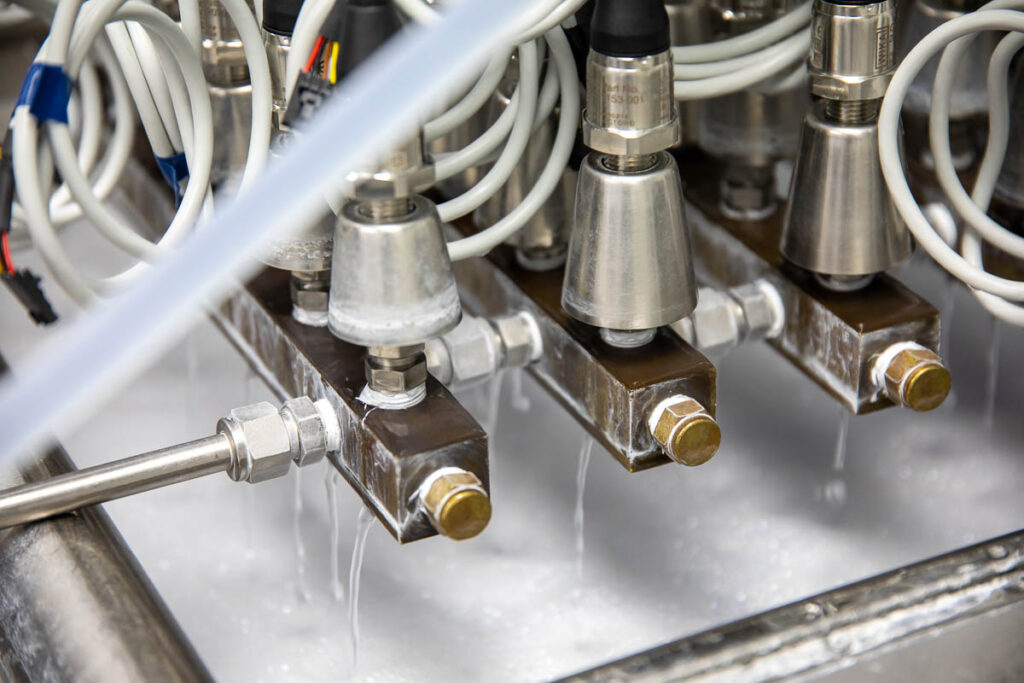
Another major change in the 2025 revision is how the standard addresses why cleaning is required.
“Fire risk just wasn’t emphasized enough before,” Brad notes. “Cleaning for oxygen service is fundamentally a fire-prevention measure. Most other oxygen safety measures build on this foundation.”
The revised Significance and Use section now makes that point especially clear. Cleanliness is presented as a foundational ignition-risk mitigation strategy, alongside design, materials selection, and operating practices.
Emphasizing Risk-Based Decision-Making
ASTM G93 has always been grounded in best practices for oxygen cleaning, but the 2025 revision now adds perspective on factors that influence the ignition risk of contaminants and ultimately affect the assignment of a cleaning level. Some of these factors include:
- Pressure and pressurization rate
- Oxygen concentration
- System geometry and flow characteristics
- Contaminant type, quantity, and migration likelihood
Nonvolatile residues (NVRs), such as oils and greases, and particulate contamination are treated as distinct hazards with different ignition mechanisms and risk profiles.
“For NVRs, adiabatic compression is often the dominant ignition threat,” Brad explains. “That’s been studied extensively — for example, in NASA White Sands Test Facility testing — and that data underpins some of the recommended cleanliness levels.”
Particulates, by contrast, involve more complex and less quantified mechanisms, such as particle impact.
WHA’s Elliot Forsyth is a former ASTM G04 Committee chair who has also been involved in oxygen safety consulting and standards development for decades. He notes that much of the guidance on particulate cleanliness is informed by a combination of historical safe-use data and emerging test data.
“What the revision does,” he says, “is give people a framework for thinking about these risks, so choosing a particle cleanliness level makes sense.”
“Oxygen cleanliness isn’t one-size-fits-all. If your use conditions are more severe, your cleanliness requirements may need to be more stringent — and that’s a risk decision, not a checkbox.” — Brad Forsyth
Cleanliness Levels: Clarity Without Prescription
One area that has generated significant confusion in industry, including earlier editions of G93, was cleanliness levels — particularly what levels are appropriate and how to specify them.
The revised standard provides updated “coding” conventions so cleanliness requirements can be clearly written into specifications and procurement documents
Importantly, the standard still avoids prescribing a single “correct” level for all applications. Instead, it provides examples, context, and guidance so users can justify their selections based on risk.
“The levels of cleanliness we list in the standard aren’t arbitrary,” Brad says. “They’re informed, at least in part, by test data — experiments that show under what conditions contaminants ignite.”
Cleaning Methods vs. Cleaning Fluids
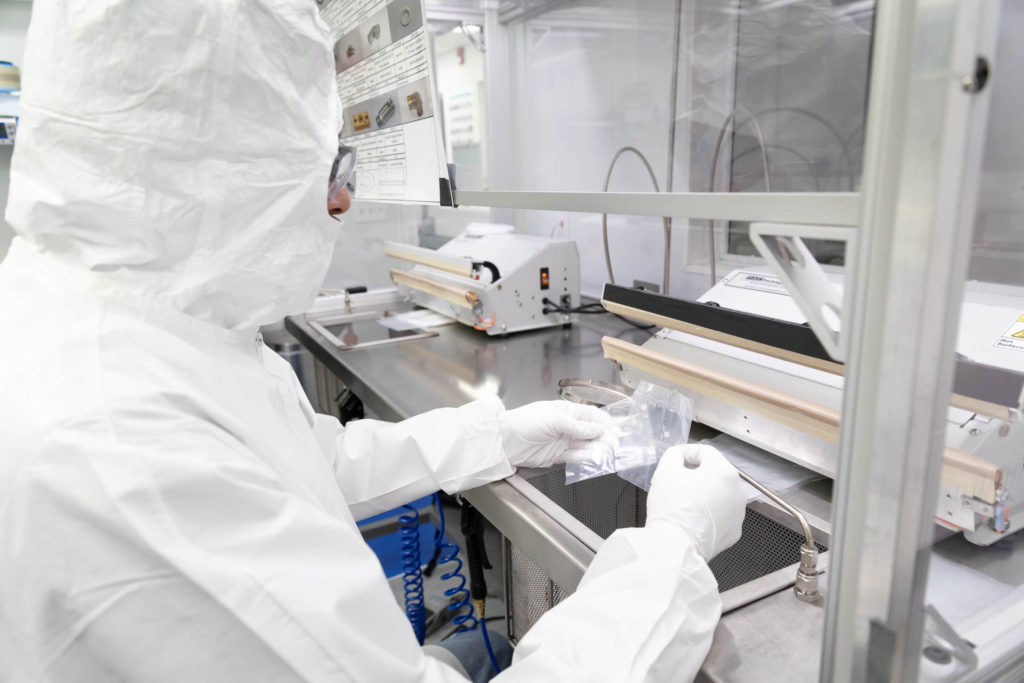
Another significant structural change in ASTM G93-2025 is the separation of cleaning methods from cleaning fluids.
“In the past, those concepts were often blended together,” Brad explains. “Now we clearly distinguish between methods — such as ultrasonic cleaning, flushing, or other mechanical cleaning methods — and the cleaning agents that would support those methods.”
Each cleaning method is described using a consistent structure:
- Target contaminants
- Achievable cleanliness levels
- Applicability and limitations
- Best practices and precautions
This reorganization helps users evaluate their options for cleaning and make an informed decision about what is best for their application.
Cleanliness Evaluation vs. Verification
Another significant update in the ASTM G93-2025 revision is in the area of cleanliness evaluation.
“First, you design a cleaning process to achieve a target cleanliness level,” Brad says. “Then you have to ask: how do you know that process is working?”
The standard now clearly distinguishes between:
- Qualitative inspection methods (e.g., visual or UV inspection), which are useful for detecting gross contamination (visible levels)
- Quantitative methods, which are required to verify cleanliness levels against a specification
“What the revision really tries to do,” Elliot Forsyth adds, “is make people aware of the limitations of each method — and avoid the false confidence that can come from relying on visual inspection alone.”
“Visual inspection methods alone cannot verify most oxygen service cleanliness levels. They are simply below what you can see with the human eye.” — Elliot Forsyth
Procurement, Traceability, and the Full Lifecycle
ASTM G93-2025 also expands guidance on areas implicated in multiple incidents and as important as cleanliness itself: procurement, packaging, preservation, and assembly.
The standard now includes explicit discussion of how to reference cleanliness requirements when procuring cleaning services or oxygen-cleaned components, and how to maintain cleanliness through handling and system assembly.
“It’s full lifecycle,” Brad explains, “It starts with identifying a cleanliness need and it follows that all the way through specifying, cleaning, verifying, packaging, and preserving. It’s now more comprehensive than anything else out there.”
A Consensus Effort
Behind the technical changes was a long, collaborative process. The G93 task group included experts from industrial gas companies, medical device manufacturers, aerospace organizations, and other sectors — all working toward full consensus over many years.
“We scrutinized every sentence,” Brad recalls. “When you have ten or fifteen experts debating wording line by line, it takes time. But that’s what full consensus looks like.”
For Brad, the accomplishment is both professional and personal.
“I’m honestly most proud of getting it across the finish line,” he says. “But I also think it’s a much better document — more readable, more usable, and more reflective of what we’re trying to communicate about safety.”
Reflecting Forward
For engineers, OEMs, and others responsible for oxygen-service equipment, the message of ASTM G93-2025 is straightforward: cleanliness decisions should be intentional, justified, and aligned with risk.
If you need support interpreting or applying ASTM G93-2025 to your own equipment, cleaning processes, or hazard analyses, WHA International provides consulting, evaluation, and training services to help organizations make defensible, risk-based decisions.
Share this article
Related Articles
Materials Selection and Compliance in Industrial Oxygen Piping Systems
Because materials can ignite and burn more easily in the presence of oxygen, selecting compatible materials is…
Key Oxygen Safety Discussions from the ASTM G04 Committee Meeting at MIT
Officers from WHA International participated in the June 2026 ASTM G04 Committee Meeting, hosted by the Massachusetts…
Case Study: Steel Mill Industrial Oxygen Fire
In 2013, an industrial oxygen fire tore through a new oxygen supply system feeding an electric arc…
Request an expert
consultation
Contact us to request a free consultation with an experienced engineer who can help you better understand your needs and our solutions.