
Case Study: Recreating High-Energy Cylinder Ruptures at Full Scale
Highlights
- WHA worked with the U.S. Department of Transportation (DOT) Pipeline and Hazardous Materials Safety Administration (PHMSA) to safely recreate a rare, high-energy cylinder rupture.
- The team engineered a custom full-scale test environment, including a reinforced rupture bunker, automated pressure system, remote control room, and high-speed instrumentation.
- WHA’s reactive-gas expertise and specialized high-energy test capabilities allowed investigators to reproduce the rupture mechanism under controlled conditions.
Several years ago, personnel were unloading a high-pressure aluminum cylinder containing a reactive synthesis gas blend when it suddenly ruptured. The event was violent and unusual. Instead of failing along a single seam — as aluminum cylinders typically do — it fragmented into dozens of pieces, sending shrapnel across the site and tragically resulting in one fatality.
The synthesis gas mixture inside the cylinder contained acetylene (C₂H₂), CO, H₂, various hydrocarbons, and alcohol intermediates. When the cylinder was dropped, the physical shock induced a reaction that triggered rapid acetylene decomposition. Within fractions of a second, the gas reacted to form simpler molecules, generating intense heat and pressure that exceeded the cylinder’s limits.
The resulting extreme fragmentation made the case particularly unique. Why had this cylinder shattered so dramatically? Could certain environmental or material factors have played a role? Would the same thing happen again under similar conditions?
To answer those questions, the U.S. Department of Transportation (DOT) Pipeline and Hazardous Materials Safety Administration (PHMSA) turned to WHA International. The DOT-PHMSA recognized an industry need to proactively seek answers through additional research. They were concerned with public safety and appropriate industry regulations to advance safety through full-scale cylinder-rupture research.
The Challenge — Recreating a High-Risk Rupture
Investigators quickly recognized that the only path to meaningful answers was to recreate the failure at full scale under controlled and instrumented conditions. But replicating an energetic gas-phase cylinder rupture is not a typical laboratory task — the energy release is massive, the fragmentation unpredictable, and the safety considerations extreme.
Very few organizations in the world have the combination of:
- Full-scale, remote high-energy test facilities
- Custom explosive-force enclosures
- Mechanical and chemical hazard expertise
- Experienced operators trained in reactive-gas testing
- Integrated engineering, instrumentation, and failure analysis specialists
WHA has all of these in-house.
“This project required a level of planning, engineering, and safety control that just doesn’t exist in most labs,” explains Danielle “Dani” Murphy, Ph.D., one of WHA’s principal investigators. “If you want to truly understand an event like this, you can’t rely only on small-scale data. The geometry and the dynamics are different at full scale.”

Engineering the Test Environment
To support this program, WHA’s custom testing team designed a specialized test environment at the company’s remote proving grounds outside Las Cruces, NM.
A purpose-built test bunker
WHA constructed a modular, high-strength concrete bunker — large enough to contain full-scale industrial cylinders and capable of absorbing high-energy projectile impacts. The structure included:
- Multiple layers of reinforced concrete blocks
- Steel grates and deflection screens
- A winding entryway to block direct line-of-sight escape paths
- Reinforced ports for gas lines, ignition leads, sensors, and cameras
A fully remote control and monitoring system
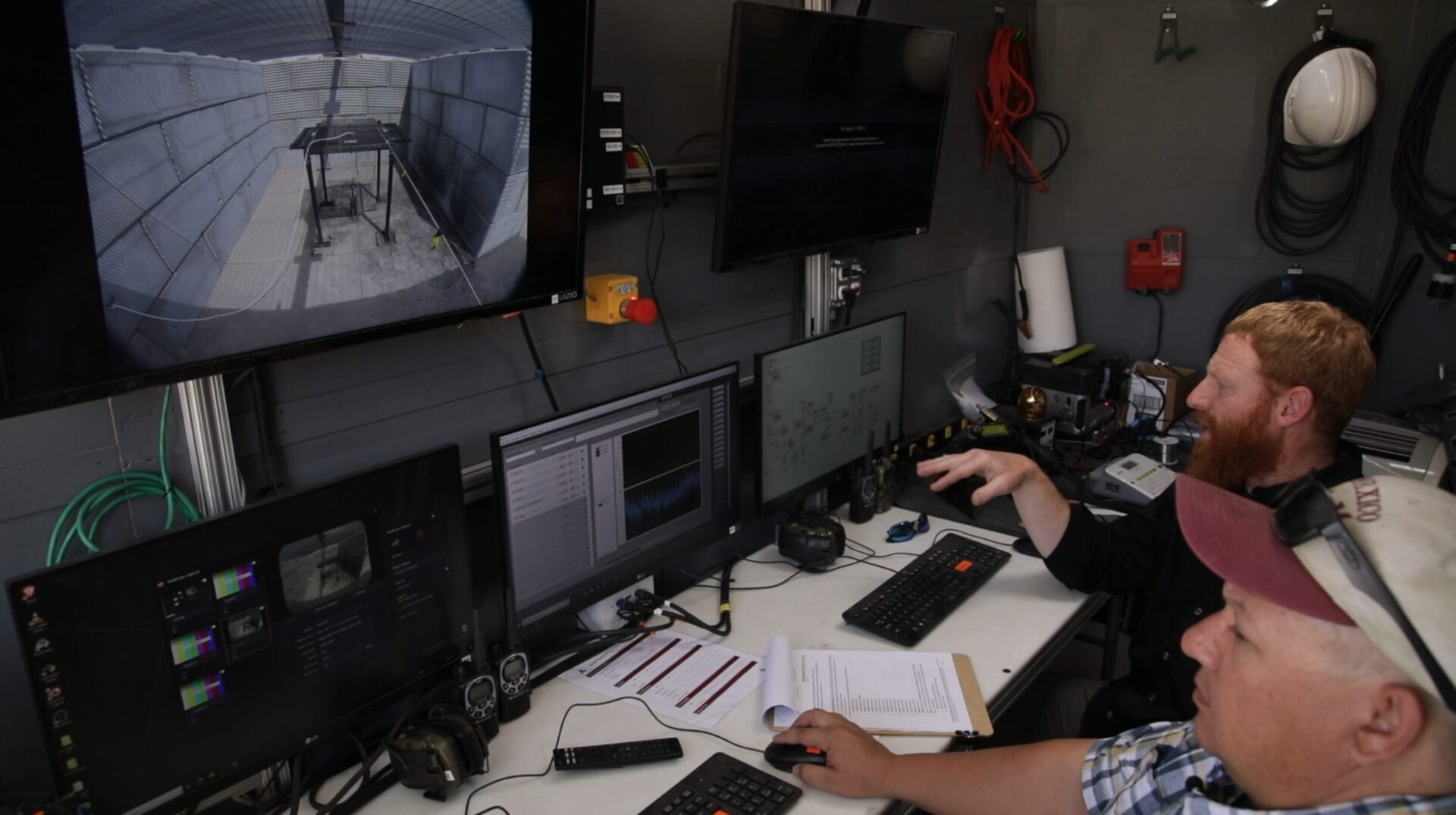
Operators monitored the tests from an enclosed control room located safely behind a hill. From there, they controlled:
- Pressurization systems
- Ignition triggers
- High-speed cameras (up to 2,000 fps)
- Pressure transducers
- Temperature sensors
- Multiple synchronized video feeds
WHA engineers also designed and implemented a specialized gas-blending system that could be operated remotely and equipped with fuel-gas monitors and atmospheric safety instrumentation. This was essential for testing gas blends capable of decomposition.
“You can only learn so much from the aftermath of an accident. At some point, if you really want to understand in depth what happened, you have to recreate it safely and observe it directly. That’s what our facilities allow us to do.” – Brian Anderson, Senior Mechanical Engineer
Designing a Custom Test Program for Full-Scale, High-Energy Ruptures
The DOT program was designed to explore the conditions surrounding the original rupture, so the WHA team staged tests across several categories.
1. Small-scale cylinders
The program began with reduced-size cylinders to confirm the basic setup and ensure safety systems were performing as expected. Even at this early stage, high-energy ruptures revealed valuable technical clues about fragmentation patterns and initiation sites.
2. Full-scale cylinders
Once the team validated the approach, WHA moved to full industrial K-bottle cylinders (9 in × 48 in) — the same size class involved in the original incident.
“We didn’t do anything exotic or destructive to the cylinders,” explains Brian Anderson. “We used brand-new cylinders straight from the supplier, filled them with the defined test mixtures, waited only a few minutes, and initiated decomposition through an electrical energy input. They all failed in almost exactly the same way as in the incident.”
3. Controlled decomposition events
WHA blended its own acetylene/CO/H₂ mixtures and installed custom ignition assemblies inside the cylinders to initiate decomposition. This required precise gas blending, rigorous leak control, and specialized procedures to avoid unintended ignition.
Because the decomposition was not a combustion event (no oxygen present), the team had to engineer ignition systems that could safely initiate the reaction without introducing external oxidants.
“This isn’t combustion. There’s no oxygen in the cylinder. It’s a rapid decomposition reaction that generates heat and pressure incredibly quickly. Understanding that behavior was a key part of the test program.” – Danielle “Dani” Murphy, Ph.D., Principal Engineer, Hydrogen Services Lead

4. Rapid pneumatic pressurization tests
To isolate the cause of high fragmentation in the cylinders containing reactive gas, WHA tested full-scale cylinders to failure using pressurization with 100% nitrogen. This allowed the team to compare the behavior of cylinders under inert and under different pressure-rise conditions.
This involved engineering a high-flow pneumatic system capable of sending thousands of PSI of nitrogen into the cylinder through a 1.5-inch line in under a second. This setup demanded exceptional control and safety margins.
“For the rapid-pressurization tests, we built a system that could push thousands of PSI of nitrogen into a cylinder in under a second. It’s like opening a floodgate — the engineering and safety considerations are enormous.” – Brian Anderson, Senior Mechanical Engineer
Safety, Creativity, and Troubleshooting
Large-scale reactive-gas and pneumatic testing isn’t just engineering; it’s procedural science and constant problem-solving.
“Much of what we do in programs like this is creative troubleshooting,” says Dani. “You learn by iteration. You test, you study the response, and you adjust. That’s experimental science.”
Other challenges included:
- Ranging pressurization rates (“between fast and faster,” as Dani put it)
- Establishing complete mixing prior to ignition
- Understanding ignition sensitivity and triggering consistency
- Monitoring CO levels around the site
- Adjusting geometry and shielding to contain fragments
- Instrumenting cylinders for pressure and deformation without interfering with rupture behavior
Despite these challenges, the team successfully reproduced the high-fragmentation rupture over a dozen times under controlled conditions.
Where the Program Stands
The test program is now complete, and DOT-PHMSA has authorized WHA to prepare a journal article for peer review. This will be the first step in sharing the research with industry professionals for further evaluation and to promote safety.
The results advanced our understanding of cylinder rupture mechanisms under high strain rates, and future work is expected. Through scientific understanding, WHA hopes to influence safer storage of reactive gases.

Harnessing WHA’s Unique Capabilities and Expertise
Performing this type of work requires a unique skill set and a rare combination of capabilities:
- Full-scale high-energy test facilities
- Remote-operation infrastructure
- Reactive-gas handling expertise
- Custom fixture and bunker design
- Experienced in high-speed data acquisition
- Integrated failure analysis and metallurgical support
- Engineers who understand ignition, pressurization, and reaction dynamics
Most labs can run benchtop combustion or small-scale pressure tests. Very few can safely rupture industrial cylinders under pneumatic conditions, collect meaningful engineering data, and perform the metallurgical and forensic work afterward.
That combination — engineering creativity, deep knowledge of reactive gases, and full-scale capability — is what enabled WHA to execute this program successfully.
“Organizations come to us when the problem is too dangerous or too complex for a standard lab. Our job is to design a test that answers the question — and to do it safely at full scale.” – Brian Anderson, Senior Mechanical Engineer
Partner With WHA on Complex Custom Testing
WHA helps organizations answer hard questions — the ones that can’t be solved with off-the-shelf equipment or standard lab setups.
If your organization needs safe full-scale or high-energy testing, WHA can help design a custom program tailored to your application.
Contact WHA to discuss your system or explore specialized testing options.
Share this article
Related Articles
What New CSA Group Research Reveals about Hydrogen Leak Testing Gaps
How do we reliably detect, measure, and manage hydrogen leaks? A new CSA Group research study takes…
Case Study: Steel Mill Industrial Oxygen Fire
In 2013, an industrial oxygen fire tore through a new oxygen supply system feeding an electric arc…

WHA Failure Analysis Legacy: Expert Witness
What makes an expert witness effective in the courtroom? Barry Newton: It’s about communication. A forensic engineer…
Request an expert
consultation
Contact us to request a free consultation with an experienced engineer who can help you better understand your needs and our solutions.